
When you’re buying a luxury property, it’s easy to focus entirely on the finishes, the floor plan, and the location. But none of that matters if the developer behind the project can’t actually complete it. A financially stable real estate developer is what stands between a beautifully rendered brochure and a property you actually receive – on time, built to standard, with clean title, and with someone accountable after handover. The building is only one part of what you’re buying. The other part is the developer’s ability to deliver it.
This distinction matters more as the price climbs. A delay or funding gap on a modest project is frustrating. On a property worth hundreds of millions of naira, it can mean years of tied-up capital, unfinished construction, or a legal dispute over land you thought was clean. Before you commit a deposit, it’s worth knowing exactly what financial stability looks like – and how to check for it yourself.
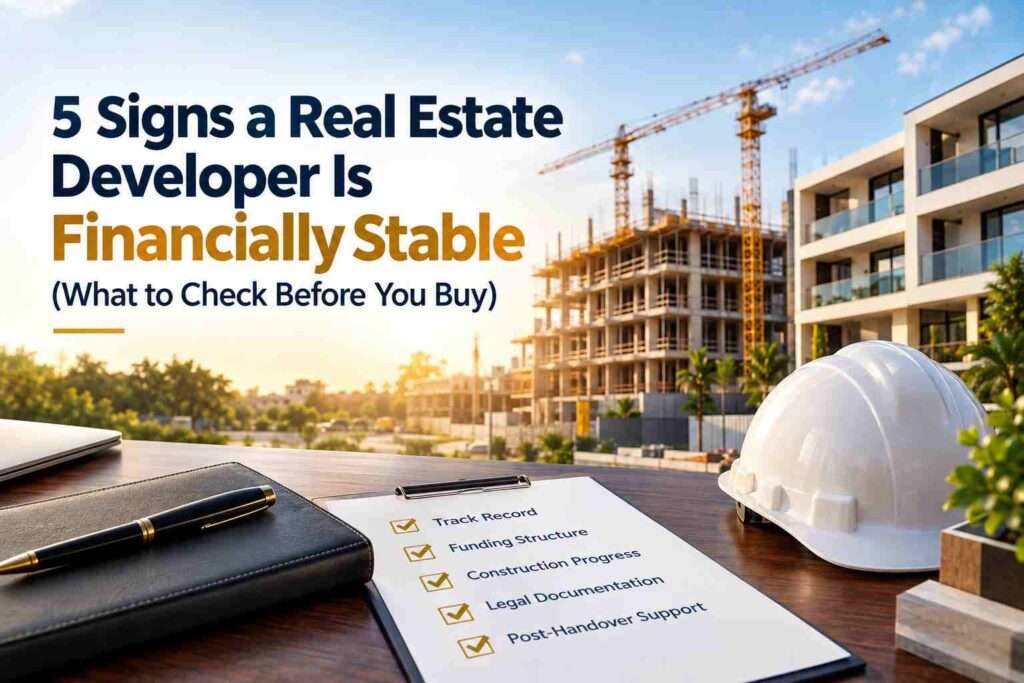
5 Signs a Real Estate Developer Is Financially Stable
These five signs won’t give you absolute certainty; no external checklist can. But together, they give you a realistic, evidence-based picture of whether a developer is positioned to complete what they’re selling.
1. A Strong Track Record of Completed Projects
The single best predictor of whether a developer will complete your project is whether they’ve completed similar projects before.
Look at what they’ve actually delivered, not just what they’re currently marketing:
- How many developments have they completed, and over what timeframe?
- Were those projects delivered close to the promised timeline, or repeatedly delayed?
- Is the quality of finish in completed projects consistent with what is being promised for the new one?
- Are previous developments still occupied, well-maintained, and holding or appreciating in value?
- Can you find or speak with buyers from earlier projects about their experience?
A developer who has successfully delivered several comparable projects has demonstrated something a brochure can’t: the operational and financial capacity to see a development through to handover. A developer with no completed track record isn’t automatically untrustworthy, but it does mean you’re taking on more of the execution risk yourself, and that risk should be reflected in how much scrutiny you apply.
Ask the developer: How many projects have you completed in the last five years, and can I visit one?
Red flag: An inability or reluctance to name specific completed projects, or to let you inspect one in person.
2. Transparent Financial and Project Funding Structure
You don’t need access to a developer’s balance sheet to get a reasonable sense of how a project is being funded, but you should understand, at a high level, where the money is coming from.
Most developments are financed through some combination of:
- Developer equity
- Bank or institutional construction financing
- Investor or joint-venture funding
- Buyer presales and deposits
None of these funding sources is inherently a red flag on its own. Presales are a completely normal part of real estate development globally. What matters is whether the project appears overly dependent on continuous buyer deposits to keep construction moving, with little evidence of any other funding base. A project funded entirely by buyer payments, with no bank facility, institutional partner, or developer equity behind it, carries more risk if sales slow down mid-construction.
Ask the developer: How is this project financed, and is there bank or institutional funding involved alongside presales?
Red flag: Vague or evasive answers about funding, or clear signals that construction progress is tightly tied to how quickly new units are sold.
Also Read: Off-plan Property Risks
3. Consistent Construction Progress and Ability to Meet Delivery Commitments
Physical progress on-site is one of the most direct signals a buyer can observe firsthand.
Look for:
- Visible, steady construction activity that matches the project’s stated timeline
- Evidence of an organised site – active contractors, equipment, and materials rather than a stalled or dormant site
- A project management team that can speak knowledgeably about milestones and next steps
- A history of hitting, or reasonably explaining deviations from, previous delivery dates
- Clear, proactive communication with buyers during construction, rather than silence between payment requests
Construction activity by itself doesn’t prove financial strength, a site can look busy in the short term even if funding is fragile. But consistent, well-managed progress, combined with credible answers about funding and past delivery, is a meaningfully positive sign.
Ask the developer: What is the current construction milestone, and how does that compare with the original project timeline?
Red flag: A site that has been visibly inactive for an extended period, or repeated, unexplained shifts in the completion date.
4. Proper Documentation, Corporate Transparency and Legal Compliance
This is where many buyers underinvest their attention, and where the financial risk of a bad purchase is often greatest.
Before committing, you or your legal adviser should be able to review:
- The land title and history of ownership
- Certificate of Occupancy (C of O) status
- Governor’s Consent, where applicable to the transaction
- Survey plans and boundary documentation
- Development and building approvals from the relevant planning authority
- The developer’s corporate registration and identity
- Contract documentation governing the purchase, payment schedule, and handover terms
- The professionals involved: architects, engineers, project consultants, and legal advisers on the transaction
A financially and operationally sound developer should be able to produce this documentation without resistance. This is also an area where you should never rely solely on representations made by a sales agent. Land title verification, building approval checks, and Governor’s Consent status should be independently confirmed by a qualified Nigerian property lawyer before you pay a significant deposit.
Ask the developer: Can you provide the land title documents, Certificate of Occupancy or Governor’s Consent status, and development approval directly to my lawyer for review?
Red flag: Reluctance to share documentation, inconsistent explanations of title status, or pressure to sign and pay before your legal adviser has completed review.
Also Read: Land Title Verification
5. A Reputation for Delivering Value Beyond the Sale
What happens after handover tells you a great deal about a developer’s actual operational strength – arguably more than the marketing around the sale itself.
Consider:
- How the developer handles post-sale property management, where applicable
- Their responsiveness to maintenance issues and defect resolution after handover
- The clarity and professionalism of the handover process itself
- Ongoing estate management, where the development includes shared facilities or services
- How reachable and communicative the developer remains once your payment has been made in full
A developer that disappears after the final payment, or one whose earlier buyers report unresolved post-handover issues, is telling you something about how the business is run – and, by extension, about the risk profile of buying from them again.
Ask the developer: What does the post-handover support and maintenance process look like, and can I speak with a buyer who has gone through it?
Red flag: No clear answer about what happens after handover, or previous buyers describing an unresponsive developer once payment is complete.
Also Read: Buying Property in Nigeria From Abroad
How to Check if a Real Estate Developer Is Financially Stable Before You Buy
Use this as a practical checklist before you engage seriously with any developer or project:
- How many projects has the developer completed, and when?
- Can I physically inspect a completed project, not just the one being sold?
- Can I speak with previous buyers about their experience?
- What is the realistic expected completion date for this project, and what has the developer’s track record been against past deadlines?
- What is the project’s funding structure, and is it reliant primarily on buyer deposits?
- What happens contractually and financially if construction is delayed?
- What documentation is available for the land and the development, and can it be shared directly with my legal adviser?
- Who are the contractors, architects, engineers, and legal advisers involved in this project?
- What is the developer’s broader history; how long have they operated, and under what corporate structure?
- What does the process look like after handover, including maintenance and defect resolution?
- Is there an independent legal professional reviewing the transaction on my behalf, separate from the developer’s own team?
Working through this list before signing anything gives you a realistic, evidence-based view of the developer – not just the project.
Also Read: Property Investment in Lagos
Red Flags That May Indicate a Property Developer Deserves Further Due Diligence
None of the following automatically prove a developer is financially unstable. They are reasons to slow down and investigate further before proceeding:
- Repeated, unexplained project delays with shifting completion dates
- Poor or inconsistent communication, especially once a deposit has been paid
- No verifiable evidence of previously completed, occupied projects
- Pressure to make an immediate payment or “lock in” pricing before you’ve completed due diligence
- Inability or unwillingness to provide land title, approval, or corporate documentation
- Inconsistencies between what’s said verbally and what’s in the contract or marketing materials
- Unclear or disputed land ownership or title information
- Frequent changes to delivery promises without clear explanation
- Poor or absent after-sales support reported by earlier buyers
- Aggressive sales claims – guaranteed returns, “limited time” pressure, unverifiable statistics without supporting evidence
If you notice several of these together, that’s a strong signal to pause and dig deeper, ideally with independent legal and professional advice, before committing further funds.
Why Financial Stability Matters Even More for Luxury Property Buyers
The stakes here are different from a modest residential purchase. When a property carries a price of N200 million, N500 million, or over N1 billion, the consequences of getting the developer assessment wrong like a stalled project, a title dispute, years of tied-up capital are proportionally much larger.
That’s why a serious luxury property purchase should be evaluated across the full picture, not just the unit itself:
The property + the location + the title + the developer + the development + the investment case.
A beautiful unit in a prime location doesn’t offset weak title, an unstable funding structure, or a developer with no delivery track record. Sophisticated buyers evaluate all six of these dimensions together, because a failure in any one of them can undermine the value of the rest.
Also Read: How to buy property in Nigeria
Considering a Luxury Property in Lagos?
Don’t make a N200 million, N500 million, or N1 billion decision based on photographs and promises alone. The difference between a strong investment and a costly mistake often comes down to the diligence done before the deposit is paid, not after.
We works with serious buyers to identify and evaluate premium property opportunities across Lagos, with attention to the developer, the documentation, and the investment case – not just the finish and the floor plan.
Explore Luxury Properties in Lagos
Speak With a Teta Homes Property Consultant
How do I know if a real estate developer is financially stable?
Look at their track record of completed projects, how the current project is funded, whether construction is progressing consistently, and whether they provide full documentation without resistance.
What documents should I check before buying from a developer?
Land title, Certificate of Occupancy or Governor’s Consent status, survey plans, development and building approvals, and the sale contract – ideally reviewed by an independent property lawyer.
How can I verify a property developer in Nigeria?
Confirm their corporate registration, review completed past projects in person, speak with previous buyers, and have a qualified lawyer independently verify land title and approvals.
What are the risks of buying off-plan property?
Construction delays, funding shortfalls, changes to the final specification, and, in the worst cases, projects that stall entirely before completion.
Should I buy property directly from a developer?
It can be a legitimate way to buy, but it still requires the same due diligence as any other purchase: independent legal review, title verification, and evaluation of the developer’s track record.
What should I check before paying a property deposit?
The developer’s completed project history, the funding structure, land title status, and full contract terms – ideally with a legal adviser reviewing the transaction before any funds are paid.
Why is a developer’s track record important?
Past delivery performance is one of the strongest available indicators of whether a developer has the operational and financial capacity to complete a new project.
What should luxury property buyers consider before purchasing?
The property, the location, the title, the developer’s financial stability, the development itself, and the broader investment case – evaluated together, not in isolation.