
If you’re thinking long-term wealth, not just quick cash, you should look beyond buildings and plots of land.
There’s a quieter, more powerful asset class that many smart investors are moving into: agricultural real estate. And right at the centre of it is one opportunity that keeps showing up again and again: Oil palm investment in Nigeria.
From food production to industrial use, palm oil is one of the most demanded commodities in the country. Yet, Nigeria still struggles to meet its own consumption needs, thereby creating a massive opportunity for investors who understand how to position early.
So why are more investors turning their attention to oil palm estates? Let’s break it down.
Also read: The Secret to Passive Farmland Investment
What is Oil Palm Estate Investment?
Oil palm estate investment simply means owning or investing in land cultivated with oil palm trees for commercial production.
Instead of buying land and waiting for appreciation alone, you’re combining:
- Land ownership (real estate)
- Agricultural production (cash flow)
- Long-term yield (compounding returns)
It’s not just land. It’s land that works for you.
1. Nigeria Has a Massive Demand–Supply Gap
One of the biggest drivers of oil palm investment in Nigeria is simple economics: Demand is far greater than supply.
Nigeria is one of the largest consumers of palm oil in Africa, yet local production consistently falls short. Industry reports and agricultural bodies have repeatedly highlighted that Nigeria imports a significant amount of palm oil annually to bridge the gap.
What does this mean for you as an investor?
- There is a ready market
- You’re not struggling to find buyers
- Prices are often supported by demand pressure
Unlike many investments where you have to create demand, here, demand already exists and keeps growing.
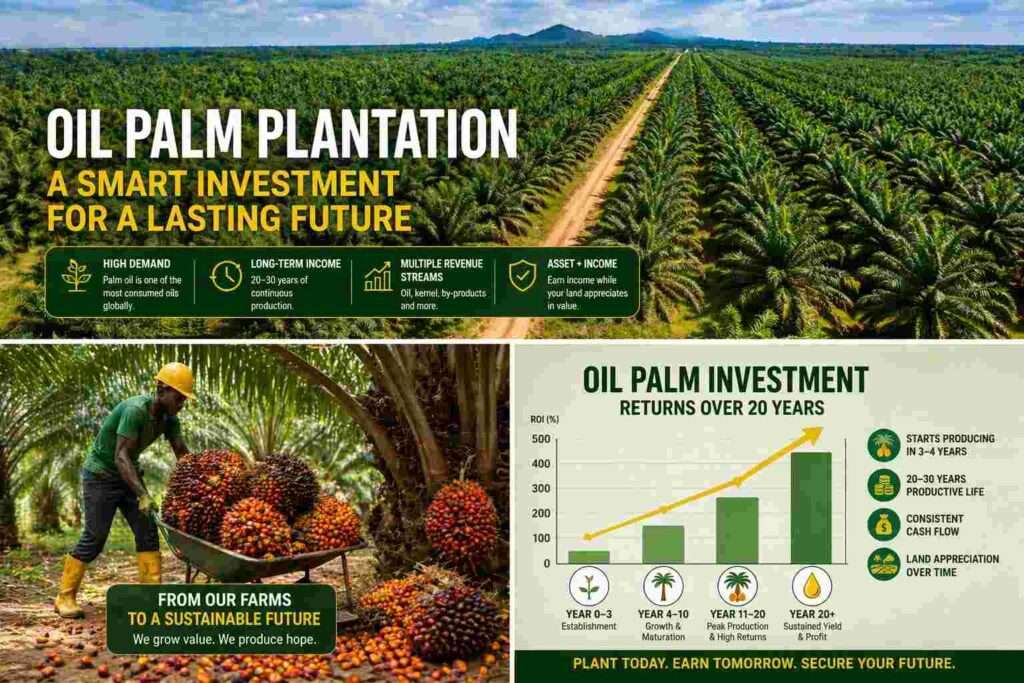
2. Long-Term, Recurring Income for 20–30 Years
Most investments either give you:
- Short-term gains, or
- Long-term appreciation
Oil palm gives you both.
Once matured (typically 3–4 years after planting), an oil palm tree can produce consistently for 20 to 30 years.
That means:
- Annual harvest cycles
- Continuous cash flow
- Income that compounds over decades
Compare that to buying land and waiting 10 years to sell.
With oil palm, your asset doesn’t just sit; it produces income every year. This is why many investors now see it as a passive income farming strategy.
3. High Yield Per Hectare Compared to Other Crops
Not all agricultural investments are equal.
Oil palm is widely regarded as one of the highest-yielding commercial crops per hectare in the world. From a single hectare, you can get:
- Fresh fruit bunches (FFB)
- Palm oil
- Palm kernel oil
- Other by-products
Compared to crops like cassava or maize, oil palm delivers more value per land unit over time. This makes it ideal for investors who want to:
- Maximize land productivity
- Build scalable agro real estate portfolios
Earn more from less land
4. Multiple Income Streams from One Investment
Here’s where oil palm becomes even more interesting. It’s not a one-income product. From a single oil palm estate, you can earn from:
- Palm oil (primary product)
- Palm kernel oil
- Palm kernel cake (used in animal feed)
- By-products for industrial use
This diversification reduces risk. If one revenue stream fluctuates, others can support your income. Compare that to rental income, where one vacant tenant affects everything.
With oil palm, your income is layered and more resilient.
5. Land Appreciation + Asset-Backed Security
Let’s not forget, this is still real estate. While your trees are producing income, your land is also:
- Increasing in value
- Benefiting from nearby development
- Becoming more desirable over time
So you’re earning in two ways:
✔ Agricultural income
✔ Land appreciation
This dual advantage is what makes tree crop investment especially powerful. You’re not choosing between cash flow and appreciation; you’re getting both.
Want to invest in Palm Haven? Chat with us now
What Makes Oil Palm Different From Other Investments?
Let’s be honest, crypto is volatile, stocks require constant monitoring, and urban real estate can be capital-intensive. But oil palm estate investment offers:
- Stability
- Tangible asset ownership
- Predictable long-term returns
- Lower emotional stress
How to Get Started with Oil Palm Investment in Nigeria
If you’re considering this path, here are simple steps:
1. Choose the Right Location
Focus on regions with:
- Good rainfall
- Fertile soil
- Existing agricultural activity
2. Verify Land Title
Ensure the land is:
- Free from disputes
- Properly documented
- Surveyed and verifiable
3. Decide Your Entry Model
You can:
- Buy and manage yourself
- Partner with an agro-investment company
- Invest in managed estates
4. Understand the Timeline
Oil palm is not a get-rich-quick scheme.
- 0–3 years: Growth phase
- 3–30 years: Production phase
5. Think Long-Term
The real power comes from:
- Scale
- Patience
- Consistency
The truth is simple: The people who build real wealth don’t just chase trends; they own assets that produce value over time. Oil palm estates sit at the intersection of real estate, agriculture, and long-term wealth creation. Today, it may look like “just farmland.” But tomorrow, it could be:
- Your passive income engine
- Your retirement plan
- Your generational wealth asset
The question is not whether oil palm works. The question is: Will you start early enough to benefit from it? 🤔
Want to start earning from agricultural real estate? Secure your oil palm estate today and build a long-term income stream that works for you for decades.